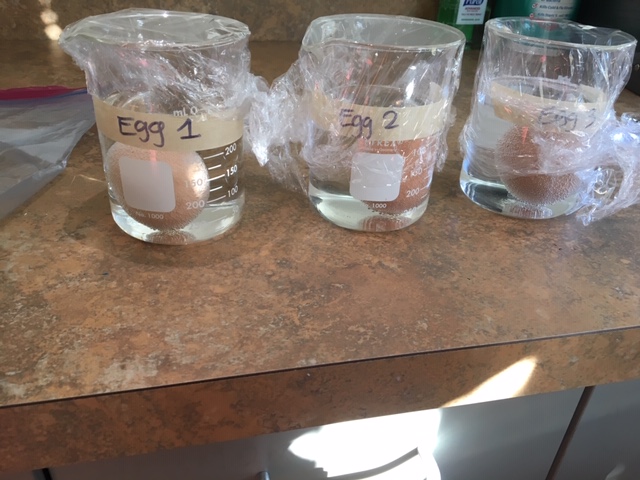
The first lab we’ve done is an easy experiment done by putting eggs in vinegar and observing the effects. The chemical process of osmosis causes the vinegar to break down the hard outer shell and leave the inner soft cell membrane, which results in a squishy (and delicate) egg.
Osmosis is how a solution with a higher concentration will pass through something to mix with a less-concentrated solution, making the two even out. It can be seen here as the higher concentrated vinegar breaks apart the shell to get inside the egg, where it stabilizes the concentration to match that of the vinegar that the egg is floating in.


- The eggs, sitting in the vinegar on day one of the experiment
Procedure
To be able to recreate this experiment at home, you’ll need a few common household items. If you don’t have them, they shouldn’t be that expensive to buy.
- Three (undamaged, no cracks or leaks) eggs, any shell color
- Household vinegar (White wine vinegar, apple cider vinegar, any type works)
- Three clear plastic or glass cups big enough to hold at least two eggs, since the eggs will expand
- Clear wrap (saran wrap)
- Paper towels
If you want to weigh them:
- Sticky notes/labels to label the eggs
- Electronic scale (grams)
Optional for parts 3 and 4:
- Cola
- Corn syrup
Step One
If you’re weighing the eggs, get out your scale and weigh them one at a time before putting them into the cups. Record the weight and make sure to clarify which egg is which.
Put one egg in each cup. Pour enough vinegar in each cup to cover the egg completely and then some. You should leave at least an extra inch of vinegar on top of the egg to make sure it will stay immersed.
Put the clear wrap on the top of the cup to keep out dust and bugs. If you want to, put a sticky note or label on the outside of the cup so you can tell your eggs apart (Egg 1, Egg 2, Egg 3, etc.)
Put the cups somewhere where they won’t be disturbed, shaken, or knocked over, and clean up any spills that might have happened when you poured the vinegar.
Step Two
Wait three days before bringing the eggs back. Lay paper towels over your work area to minimize drips, and remove the covering from the cups.
If you’re going to weigh the eggs, set out your scale as well.
Pour out the vinegar into the sink, making careful effort to not let the egg fall out without you being able to gently catch it. After emptying the cups, set them aside and rinse the eggs. Be careful, if you’re too rough the thin membrane will break!
Pat them dry and put them on the towels. If you’re weighing them, make sure to keep the labels nearby so they don’t get mixed up! Wipe the scale off in between eggs to make sure it stays clean.
(Optional) Step Three
If you want to continue the experiment, keep two of the eggs. The third one you can pop open with a soft pinch!
Wash out the cups, keeping the labels on two (if you labeled them). The third cup you can put away or discard.
Place both eggs in their correct cups, making sure not to break them open as you do so. Fill one cup up with cola and the other with corn syrup, immersing the egg as much as you can in the liquid. The eggs may float, just fill it up to the same point you did with the vinegar.
Cover them and put them away in the same place.
(Optional) Step Four
Three days later, you can take out the eggs and observe or weigh them again!
Repeat step two, and remember to be gentle so they don’t break while you get them out.


- The eggs, top view
My Results
Before vinegar (Day one):
- Egg One weighed 2.1 grams
- Egg Two weighed 2.2 grams
- Egg Three weighed 2.3 grams
After vinegar (Day three):
- Egg One broke trying to get it out 😦
- Egg Two weighed 3.1 grams
- Egg Three weighed 3.4 grams
After cola and corn syrup (Day six):
- Egg Two was in the corn syrup, it weighed 1.4 grams
- Egg Three was in the cola, it weighed 3.7 grams
 Science Experiments